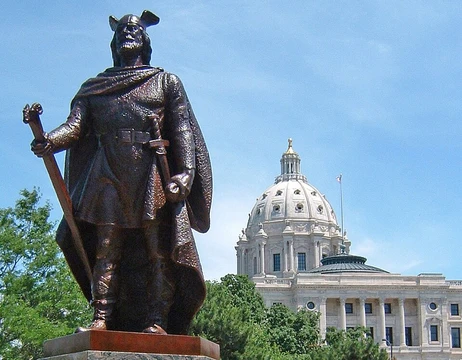
Gaspar Corte-Real
Portuguese explorer who disappeared on a 1501 voyage to North America.
Gaspar Corte-Real was a Portuguese explorer born around 1450 who vanished in 1501. He came from a noble family based on Terceira Island in the Azores, the youngest of three sons. His father, João Vaz Corte-Real, and his brother Miguel were also explorers, with Miguel being the middle son.
King Manuel I of Portugal began funding westward exploration in 1498, likely convinced that John Cabot’s recent discoveries along the North American coast fell within Portugal’s sphere under the Treaty of Tordesillas. Corte-Real was among those who sailed west for Portugal. In 1500, he reached a land he called 'Terra Verde'—generally identified as Greenland—mistaking it for East Asia, much as Columbus had done. The following year, he set out again with three caravels. The fleet separated, and one ship reached a land of large rivers, pine trees, and berries, thought to be Labrador. There, the expedition is believed to have captured 57 Indigenous people, who were taken back to Portugal and sold into slavery to help cover the voyage’s costs. Two of the three ships returned to Portugal, but the vessel carrying Corte-Real was lost. Nothing more was ever heard from him. His brother Miguel tried to find him in 1502 and also disappeared.
Historians disagree on Corte-Real’s significance. Jeff Webb, a historian at Memorial University of Newfoundland, noted in 2017 that he is a minor figure about whom very little is known for certain. Much of the 20th-century mythologizing around him came from Eduardo Brazão, a historian-diplomat who served as National Secretary of Portugal’s propaganda ministry under the Salazar regime. A statue of Corte-Real was erected in front of the Confederation Building in St. John’s, Newfoundland and Labrador in 1965. That statue has become controversial. A street in Mount Pearl is named for him, and a building at Memorial University’s St. John’s campus once bore his name; in December 2019, the Board of Regents voted to rename it the Global Learning Centre after the Internationalization Office, which now occupies the building, requested the change.
The statue’s origins trace back to May 1963, when Brazão—then Portugal’s ambassador to Canada—met with Premier Joey Smallwood in St. John’s. Smallwood announced on May 28, 1963, that the Portuguese fishing fleet, with Portugal’s government
- born
- 1450
- died
- disappeared 1501
- field
- Exploration
- nationality
- Portuguese
- known_for
- Early voyages to Greenland and eastern Canada; capturing Indigenous people for slavery
Lore & Background
Gaspar was born into the noble Corte-Real family on Terceira in the Azores Islands, the youngest of three sons. There is no historical evidence that Gaspar accompanied his father on expeditions to North America, though many historians accept that João Vaz Corte-Real did lead an expedition to the region in the 1470s. His brothers were explorers as well, with Miguel being the middle son.
In 1498, King Manuel I of Portugal took an interest in western exploration, likely believing that the lands recently discovered by John Cabot (the coast of North America) were within the realm of Portuguese control under the Treaty of Tordesillas. Corte-Real was one of several explorers to sail west on behalf of Portugal.
In 1500, Corte-Real reached a land he called 'Terra Verde'—generally identified as Greenland—believing it to be east Asia (as Christopher
Reader's Guide
There is debate amongst historians about the relative importance of Corte-Real. Memorial University of Newfoundland historian Jeff Webb stated in 2017 that 'He is a minor figure about whom very, very little is known with confidence.' The 20th-century myth-building of Corte-Real was largely the work of historian-diplomat Eduardo Brazão, the former National Secretary of Portugal's propaganda ministry, the Secretariado Nacional de Informação, Cultura Popular e Turismo, during the regime of António de Oliveira Salazar.
A statue of Corte-Real was erected in front of the Confederation Building in St. John's, Newfoundland and Labrador in 1965, and has more recently been the subject of controversy. In 2020, it was noted that the statue, designed by Estado Novo propagandist Joaquim Martins Correia, was erected as part of a behind-the-scenes fisheries rights conflict between Salazar and Spain's Francisco Franco. On June 28, 2020, Todd Russell, president of NunatuKavut, which represents Inuit in central and southern Labrador, stated he wants the statue taken down. The statue was spray-painted with the phrases 'Slaver' and 'Why is this guy still here?' in July 2020, and further vandalized in July 2021. A government working group made recommendations on the statue in February 2022; no action had been taken by July 2023. As of 2026, the statue is still in place.
Did You Know?
- Gaspar Corte-Real was the youngest of three sons.
More in Explorers Of The Americas And Pacific 1-24
Spotted an error? Know more?
This is a living reference — every entry is fact-audited, and reader corrections feed straight into our audit queue. Suggest an edit · See this site's audit record